
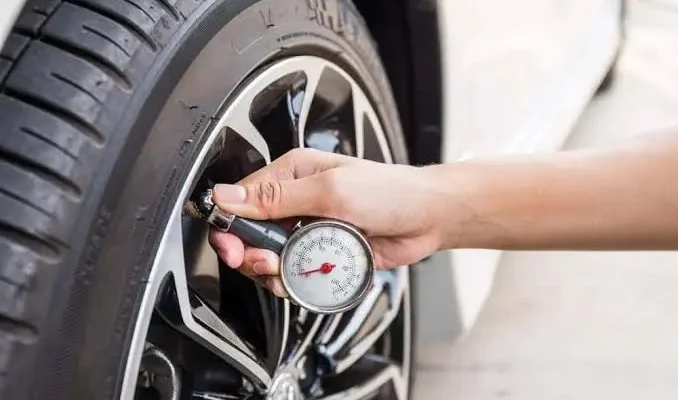
Check your tire pressure when the tires are cold, using the number on the sticker in your car’s door frame, not the number printed on the tire. It takes about five minutes with a simple gauge, and it affects safety, tire life and fuel use.
This guide shows where to find the right pressure, how to measure and inflate step by step, and what to do when the warning light comes on.
Why tire pressure matters
- Safety. Under-inflated tires flex more, heat up and can fail at speed. They also lengthen braking distances and make handling vague.
- Tire life. Too little pressure wears the outer edges of the tread. Too much wears the centre. Both mean replacing tires sooner.
- Fuel consumption. Soft tires have more rolling resistance, so the engine works harder.
- Comfort. Over-inflated tires ride harsher and grip less on wet roads.
Where to find the right pressure
Use the pressure the car maker recommends, found in one of these places:
- A sticker on the driver’s door frame (most common).
- The fuel filler flap.
- The owner’s manual.
Do not use the «max pressure» printed on the tire sidewall. That is the limit the tire can take, not the pressure your car needs.
The sticker often lists several values: front and rear tires, and a lighter or heavier load. Pick the line that matches your situation. If you often carry passengers, luggage or a trailer, use the higher-load value.
What you need
- A tire pressure gauge. A basic digital one is enough, and most petrol-station air pumps include a gauge.
- Access to an air pump or a portable compressor.
- The valve caps. Keep them somewhere safe while you work.
Step by step: check and inflate
- Measure when the tires are cold. That means the car has been parked for at least three hours, or driven only a short distance (about a mile or 1.5 km). Driving warms the air inside and raises the reading.
- Remove the valve cap from the first tire.
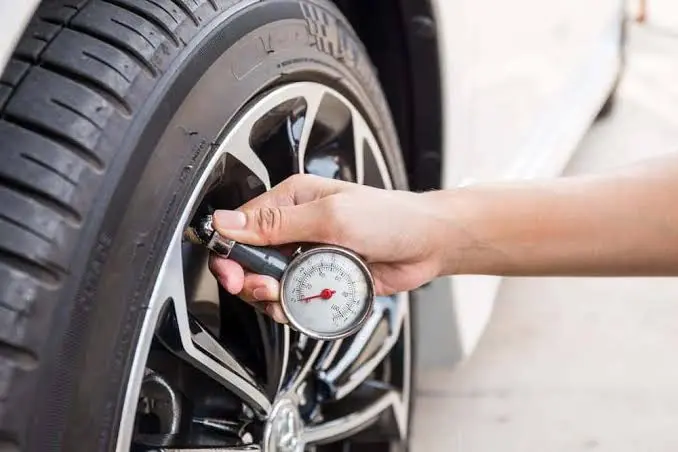
- Press the gauge firmly onto the valve until the hissing stops, and read the number.
- Compare it with the recommended pressure. Write down any difference.
- Add air in short bursts if the pressure is low, checking again after each one. It is easier to add air than to take it out.
- Release air by pressing the small pin in the centre of the valve if the pressure is too high.
- Refit the cap. It keeps dirt and moisture out of the valve.
- Repeat for all four tires, and for the spare if your car has one. Spare tires often need a higher pressure, which is printed in the manual.
If you must check the tires after driving, add about 0.2 to 0.3 bar (3 to 4 psi) to the target. Then recheck when they are cold. Never let air out of hot tires to reach the cold number, because they will end up under-inflated.
Units: bar, psi and kPa
Gauges and stickers use different units. These are the common conversions.
| bar | psi | kPa |
|---|---|---|
| 2.0 | 29 | 200 |
| 2.2 | 32 | 220 |
| 2.5 | 36 | 250 |
| 2.8 | 41 | 280 |
To convert, multiply bar by 14.5 to get psi, or by 100 to get kPa.
How temperature changes the pressure
Air contracts when it gets cold. As a rule of thumb, tire pressure drops by about 1 psi (0.07 bar) for every 10°F (about 5.5°C) of temperature drop. That is why the warning light often appears on the first cold morning of autumn. Check your tires more often when the weather changes, and before long trips. If you are changing between summer and winter tires, see our guide on when to change winter and summer tires.
The tire pressure warning light (TPMS)
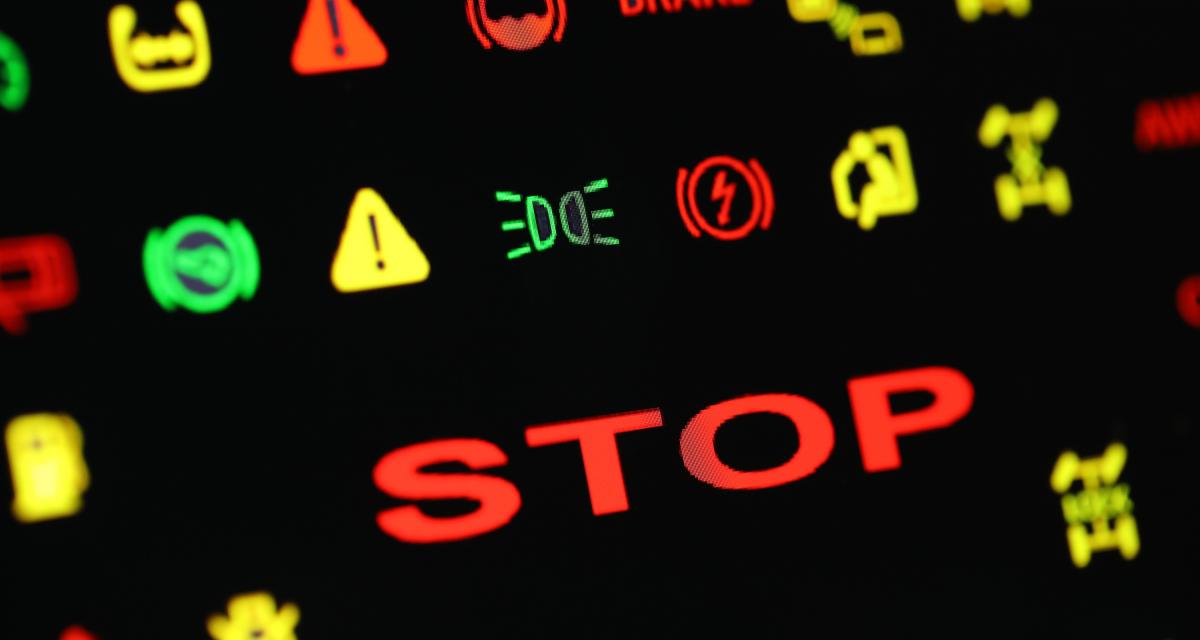
Most modern cars have a tire pressure monitoring system. The warning light looks like a flat tire with an exclamation mark.
- Light stays on: one or more tires are low. Stop somewhere safe, check all four with a gauge and inflate to the recommended pressure.
- Light flashes, then stays on: this often points to a fault in the system itself, such as a flat sensor battery. Have a garage check it.
- Light stays on after inflating: many cars need a reset. The procedure is in the owner’s manual, and it is usually a button or a menu option.
The warning light is not a replacement for checking with a gauge. Many systems only warn you when the pressure has already dropped by roughly a fifth, which is later than you would like.
When to check
- At least once a month, and before long trips.
- When the season changes and temperatures swing.
- After a puncture repair or changing a wheel.
- When you carry extra load.
When the pressure keeps dropping
If one tire loses air faster than the others, there may be a slow puncture, a damaged valve or a poor seal on the rim. Spray soapy water on the valve and tread: bubbles show where air is escaping. Have the tire inspected, and check its condition with our guide on how to check tire wear. For a full routine, read our tire maintenance guide.
FAQ
Should I fill tires to the number on the tire? No. That number is the maximum, not the recommendation. Use the sticker or the manual.
Is it safe to check tires at a petrol station? Yes, but those gauges can be inaccurate. A personal gauge gives more consistent readings.
Do front and rear tires need the same pressure? Not always. Many cars specify different values, so check the sticker.
Does the pressure change when the tires are loaded? Many cars list a higher pressure for full loads. Follow the sticker or the manual.
Latest Posts Published
How to Check and Set Your Tire Pressure Correctly
How to Jump-Start a Car Safely: Step-by-Step Guide

AI in Cars 2026: How Smart Cabins Are Tracking Your Every Move

Los 10 trabajos mejor pagados en España que nadie menciona
Diesel hybrid car: I know everything
How to get rid of winter humidity?

That’s why it will explode sales
Become unbeatable with the light witnesses of your dashboard