
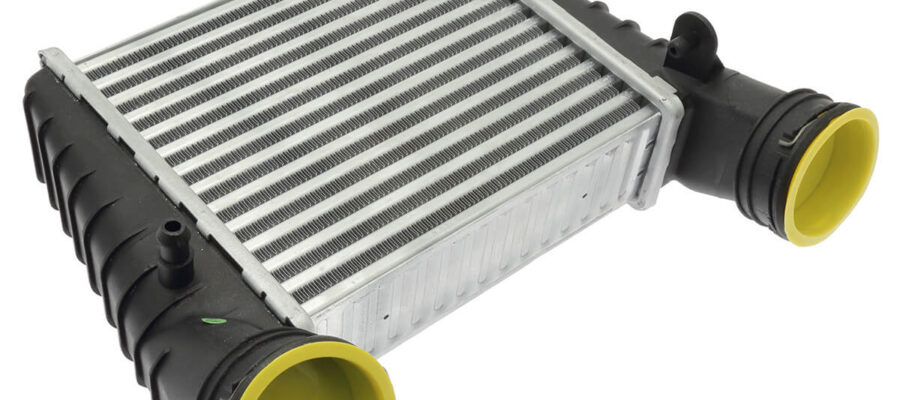
A failing intercooler or intercooler hose usually shows up as a sudden loss of power, a whistling or hissing sound when you accelerate, and black smoke on diesel engines. In most cases the cause is a split hose or a loose clamp, which is usually simpler to fix than replacing the whole intercooler.
This guide explains what the intercooler does, how to recognise the symptoms, what else can cause the same signs, how a garage tests for leaks, and whether you can keep driving.
What does an intercooler do?
A turbocharger compresses the air that goes into the engine. Compressing air heats it, and hot air is less dense, so it carries less oxygen. The intercooler (also called a charge air cooler) is a radiator that cools this compressed air before it reaches the engine. Cooler air is denser, so the engine can burn more fuel efficiently and produce more power.
On many cars the intercooler sits behind the front bumper, where it gets airflow. That position also exposes it to stones, road debris and small impacts. Some cars place it on top of the engine instead, so check your owner’s manual if you are not sure where yours is.

Intercooler vs. intercooler hose: what can fail?
The intercooler is connected to the turbo and the engine by pipes and rubber or silicone hoses. Any of these parts can leak.
| Part | What it does | Typical failure |
|---|---|---|
| Intercooler core | Cools the compressed air | Cracks from impacts, corrosion, leaking end tanks |
| Intercooler hoses | Carry air between turbo, intercooler and intake | Splits, swelling, softening from oil, age |
| Clamps and seals | Keep the connections airtight | Loosening, rust, damaged O-rings |
A leak anywhere in this path is called a boost leak. The turbo pushes air in, but part of it escapes before reaching the engine.
Symptoms of a broken intercooler or intercooler hose
- Loss of power when accelerating. Less air reaches the engine, so the car feels slow, especially under load or uphill. A burst hose can make this sudden.
- Whistling, hissing or «whoosh» noise. Air escaping under pressure makes a noise that gets louder as you press the accelerator.
- Black smoke from the exhaust (diesel). With less air, the engine burns the fuel it receives incompletely. If you notice smoke, see also our guide on white, blue and black smoke.
- Higher fuel consumption. The engine and the turbo work harder to compensate for the lost air.
- Oil around the joints. A thin oily film is common because small amounts of oil vapour pass through the intake. A heavy, dripping layer can point to a worn turbo or a crankcase ventilation problem. Our article on too much oil in the engine explains related causes.
- Warning light or limp mode. The engine computer compares the expected boost pressure with the real value. If the difference is too big, it can set a fault code and limit power. Read our guide on the dashboard warning lights and on engine computer faults.
- Hesitation or slow turbo response. The car takes longer to «wake up» when you accelerate.
Engine overheating is not a typical intercooler symptom, because the intercooler is separate from the engine’s coolant system. If your temperature gauge rises, read why the engine temperature increases.
Other problems with similar symptoms
Loss of power and black smoke have several possible causes. Before replacing parts, rule out these:
- A worn or damaged turbocharger.
- A faulty air flow meter (MAF sensor).
- A stuck or clogged EGR valve.
- A fuel pressure regulator problem.
- A clogged air filter or a blocked particulate filter.
Because of this overlap, a fault code reading is a sensible first step.
Why intercoolers and hoses fail
- Impacts: stones or road debris hitting the front of the car.
- Age and heat: rubber hoses harden, crack or swell after years of heat cycles and pressure.
- Oil contamination: oil softens rubber hoses over time.
- Loose or wrong clamps: a clamp that has lost tension lets the hose slip off under pressure.
- Corrosion: road salt and moisture can attack the intercooler’s metal parts.
- Engine tuning: higher boost pressure than the parts were designed for.
How to check for an intercooler problem
- Park the car and let the engine cool down. Never touch hoses or pipes when the engine is hot.
- Look at the hoses. Check for splits, bulging, oily wet patches and clamps that look loose or rusty.
- Inspect the intercooler. Look for bent fins, damaged end tanks or oil stains.
- Read the fault codes. A basic OBD scanner can show boost pressure or air flow related codes.
- Ask a garage for a boost leak test. The mechanic pressurises the intake system with controlled air pressure and looks or listens for leaks. This is more reliable than guessing by eye.
Can you keep driving with a broken intercooler?
A small leak may let you reach a garage, but driving for long is not a good idea. The turbo has to spin faster to compensate, a diesel engine can produce soot, and the car uses more fuel. If the hose has come off completely or the engine enters limp mode, the car will have very little power, which can be dangerous in traffic. Stop in a safe place if you see heavy smoke, hear a loud noise from the turbo, or see oil leaking quickly.
Repair options
- Tighten or replace a clamp: the simplest fix when a joint has come loose.
- Replace the hose: the most common repair. Use the correct part for your model, since the hose must withstand heat and pressure.
- Clean an oily intercooler: sometimes possible if the cause of the oil is found and fixed first.
- Replace the intercooler: usually needed if the core is cracked or leaking.
The price varies widely between models and garages, so ask for a written quote that lists parts and labour.
How to prevent intercooler problems
- Have the hoses and clamps checked at every service.
- Keep the front of the car free of mud and debris that blocks airflow.
- Fix oil leaks early, because oil damages rubber. A regular oil change with the right type of oil helps keep the turbo healthy.
- Avoid tuning that increases boost beyond what the parts can handle.
- If you drive a diesel, our list of reliable diesel engines may help when choosing a car, and engine decarbonisation explains one way to deal with carbon build-up.
FAQ
What is the difference between the intercooler and the turbo? The turbo compresses the air. The intercooler cools that compressed air afterwards.
How do I know if the problem is the hose or the intercooler? You cannot be sure without inspecting the parts or running a boost leak test. A hose failure is often more sudden, while a leaking core may cause a gradual loss of power.
Can a broken intercooler damage the engine? A leak itself is unlikely to damage the engine immediately, but running for a long time with incorrect air supply can stress the turbo and cause other problems.
Is a car without an intercooler faster? No. Without cooling, the air is hotter and less dense, which reduces power.
Last updated: October 2026.
Latest Posts Published
How to Check and Set Your Tire Pressure Correctly
How to Jump-Start a Car Safely: Step-by-Step Guide

AI in Cars 2026: How Smart Cabins Are Tracking Your Every Move

Diesel hybrid car: I know everything

How to get rid of winter humidity?

That’s why it will explode sales
Become unbeatable with the light witnesses of your dashboard


Mechanics for mannequins